

After more than a year of waiting, Valve has finally put a price on the Steam Machine, and it lands with a thud. The base model with a 512GB SSD is $1,049, with a 2TB version costing $1,349. There are two bundle options that throw in the new Steam Controller for an extra $79. Reservations are open now through a randomized lottery, the lottery closes June 25, and the first units ship June 30.
Here's the thing we keep coming back to, and it's the same thing everyone else is saying because it's true: this is a fantastic little machine that showed up at the worst possible time. Valve all but admits it. The company says its original goal for the price of the Steam Machine is no longer viable, and the prices reflect what it cost to secure components over the past six months rather than what it wanted to charge. When Valve first teased the hardware in late 2025, estimates put it under $750. Then RAMageddon hit.
What it actually is
Let's be clear about what you're buying, because "console" is doing a lot of misleading work here. The Steam Machine is a full PC in a roughly six-inch cube, running SteamOS 3, the same Arch-based Linux with a full KDE Plasma desktop mode that's on the Steam Deck. It is not locked down. You can install other stores, drop into a desktop, treat it like the Linux box it is. No platform fee to play online. Your existing Steam library just works through Proton.
Here's the spec sheet
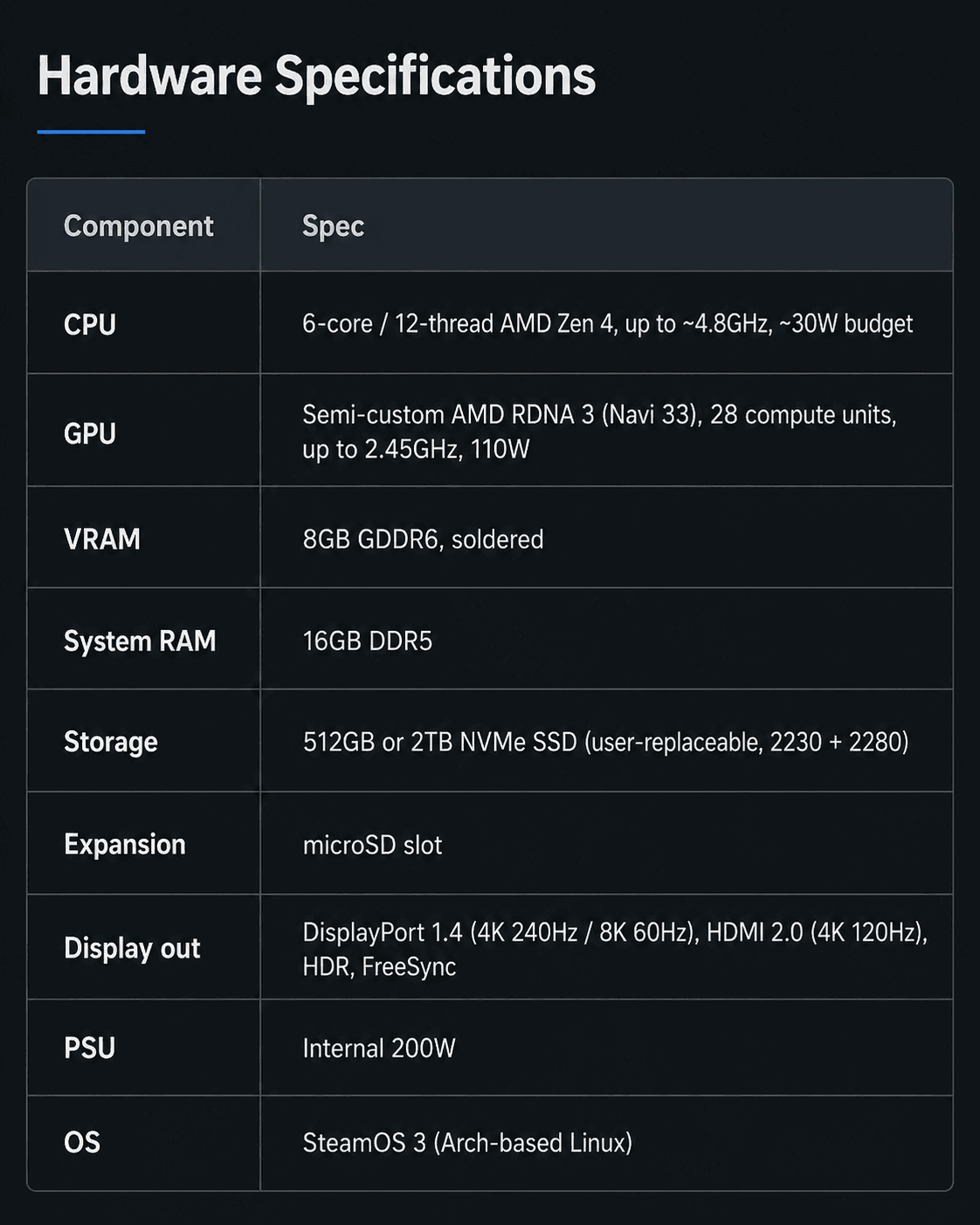
A couple of things worth flagging. The M.2 SSD is user-replaceable and the RAM is swappable, though the compact thermal design makes it more involved than a standard desktop. And it ships with FSR 4.1, which AMD released for RDNA 3 hardware on the same day as the price reveal, so the machine-learning upscaling is there from day one rather than bolted on later. For a box this size pushing games to a 4K TV, that upscaling is doing a lot of the heavy lifting.
The price problem, stated plainly
At $1,049 the Steam Machine walks into an ugly room. A PS5 Pro is $699, a base Xbox Series X is $499. Yes, those are consoles and this is a PC, and that distinction is real. But the average person standing in a living room deciding what to put under the TV does not care about your architecture diagram. They care about the number.
And this is the part that stings. If this exact machine had landed last year at that sub-$750 target, it would have been genuinely competitive, especially with Sony quietly nudging PS5 prices up in the same memory crunch. Instead, the one window where the Steam Machine could have undercut the consoles slammed shut, and Valve got caught on the wrong side of it.
Linus already built one that beats it
Predictably, the PC crowd did the obvious thing within a day. Linus Tech Tips put together a build specifically to dunk on it, starting from the same $1,050 budget. They paired a Ryzen 5 7500F (six Zen 4 cores, 12 threads, similar boost clocks) with comparable parts, taking advantage of how desperate current motherboard and case pricing has gotten, like a $130 mATX board with Wi-Fi and a $30 Zalman case with three fans and USB-C. The result outperforms the Steam Machine for the money.
But, and Linus is honest about this, you give things up. Their build is physically larger than the Steam Machine, and the CPU alone draws roughly as much power in light gaming as the entire Steam Machine does. The DIY route wins on raw frames per dollar. It does not win on size, power, noise, or the polish of the thing just working when you sit on the couch.
The feature nobody mentions until it's gone: HDMI CEC
This is the part worth dwelling on, because it's exactly the kind of detail that separates a real living-room device from a small PC you've parked next to the TV.
The Steam Machine supports HDMI CEC natively. Valve's Pierre-Loup Griffais described it well: being able to turn your TV on and off, and more importantly turn the machine on from your controller, so you sit down, press one button, and the whole thing lights up the way you'd expect from a living-room device.
That sounds trivial. It is not. HDMI CEC is the protocol that lets one HDMI device control another, the reason pressing play on a streaming stick wakes your TV and flips to the right input. The catch is that there's a special CEC pin on the APU that has to be physically wired up, and most GPU makers simply don't expose the CEC interface on their HDMI ports. So your custom-built rig, the one that beats the Steam Machine on benchmarks, very likely cannot turn your TV on. The common fix in the home-theater-PC world is to buy a Pulse-Eight USB-CEC adapter and run an extra HDMI cable through it, which works, but means spending $50 and threading more cables just to make your TV wake up.
This is the quiet argument for the Steam Machine. Linus can beat it on a spreadsheet, but the spreadsheet doesn't have a column for "press one button on the couch and everything just turns on." Valve engineered that in. Most DIY builds can't replicate it without extra hardware and a weekend of fiddling with cec-ctl scripts.
So is there a light at the end of the tunnel?
Maybe. Two of them, actually.
The first is that a real, well-built, Linux-native gaming PC is now a mainstream living-room product with Valve's full weight behind it. That matters. Every Steam Machine sold is a SteamOS install that isn't paying the Windows tax or feeding the console-platform rent machine. And Valve has said it's working to bring SteamOS to more third-party hardware, with SteamOS 3.8 able to run on your own living-room PC using whatever parts you want. The box is one option. The OS is the actual gift.
The second is more of a hope than a fact. When a $1,049 Linux box with 8GB of VRAM is the new baseline that "just works" on a TV, maybe, finally, developers feel some pressure to optimize again instead of shipping bloated messes that assume everyone has a 16GB card and brute-forces the rest. A fixed, known, modest spec target has historically been good for optimization. That's the entire reason console games often punch above their hardware. If the Steam Machine becomes a target developers actually aim for, the whole ecosystem benefits, including the people building their own boxes.
A note on where we stand
One honest caveat: everything above is built on what other people have reported, benchmarked, and gotten hands-on with. We haven't had a Steam Machine on our own bench yet. The specs, the pricing, the CEC behavior, the Linus build, it's all sourced from people who've seen it, not from us.
That's something we'd like to change. Down the line, FADElimit doing its own hardware reviews, on our own terms, with the same honesty we bring to everything else, is squarely the kind of thing this platform should be doing. Maybe YouTube too, eventually. For now, this is the informed outsider's read. But the goal is to eventually be one of the people in the room with the thing plugged in.
The Steam Machine is good. It's just expensive, late, and unlucky. None of those three are really Valve's fault, and all three are going to shape how it sells.
Disclaimer: FADElimit is an independent publication and is not affiliated with, endorsed by, sponsored by, or associated with Valve Corporation in any way. Steam® and Steam Machine™ are trademarks of Valve Corporation. All product names, logos, and brands mentioned are the property of their respective owners and are used for identification and editorial commentary only.
About the Author