
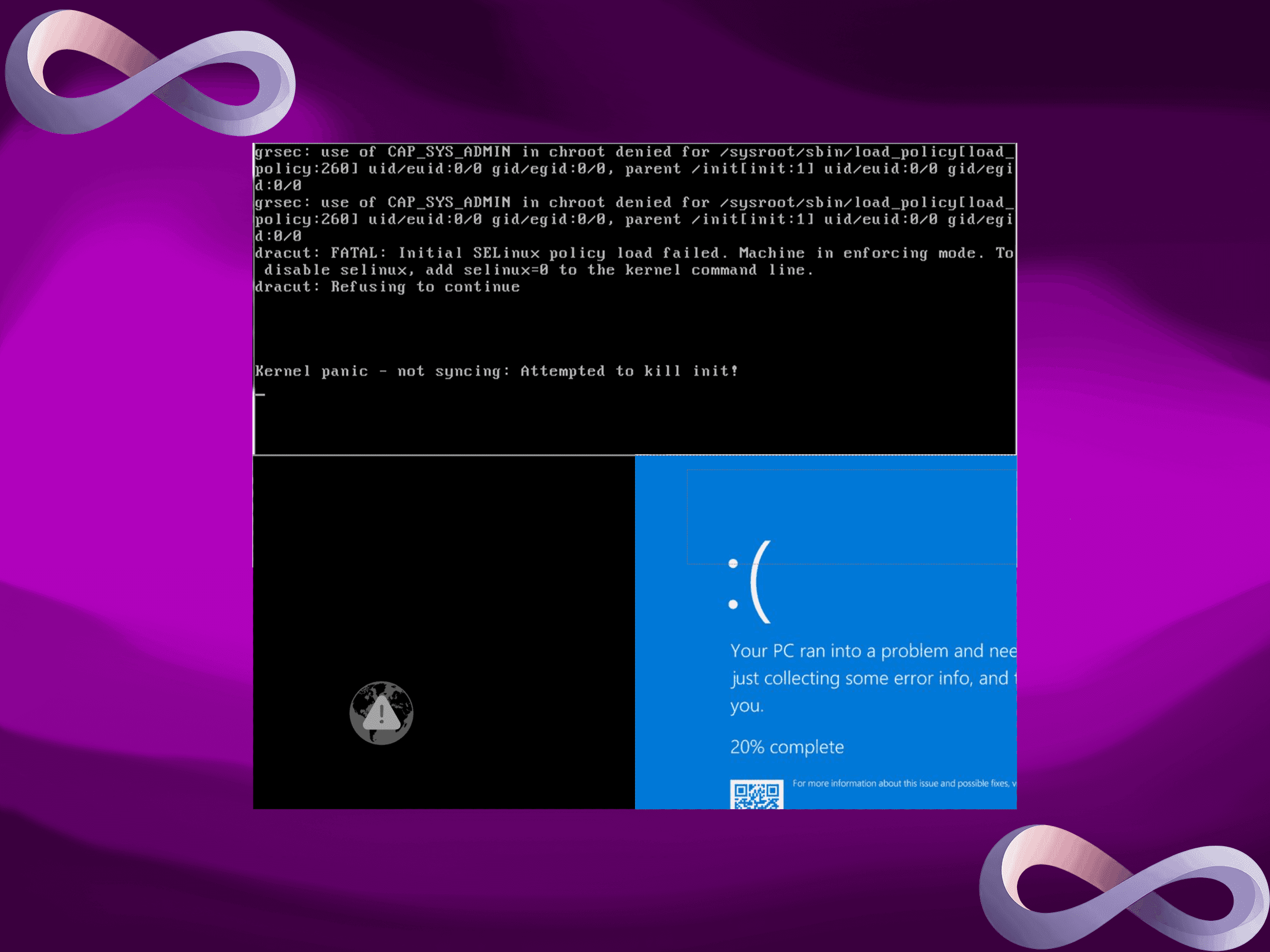
Here's a setup that would have sounded absurd ten years ago
Linux at work running DevOps pipelines, macOS as a daily personal machine, and Windows reserved for gaming. Not a thought experiment, an actual, lived configuration that makes complete sense in 2026, and says something honest about where each operating system actually stands.
Every year, someone declares it the year of the Linux desktop. Every year, it mostly isn't. But 2026 is different not because Linux finally solved everything, but because Windows has become so unreliable that the comparison actually stings, and macOS has matured into something genuinely compelling while becoming, quietly, more controlling. None of these three platforms is a simple win. Here's the real picture.
Windows 11: Microslop is a perfect name and they earned it
Windows 11 shipped in 2021 with a hardware requirement — TPM 2.0 — that locked out hundreds of millions of perfectly functional PCs. Microsoft called it a security decision. What followed was five years of updates that broke audio drivers, crashed Remote Desktop connections for months at a time, corrupted dark mode, duplicated Task Manager entries, and bricked system recovery in an update that Microsoft "accidentally" shipped and then quietly patched.
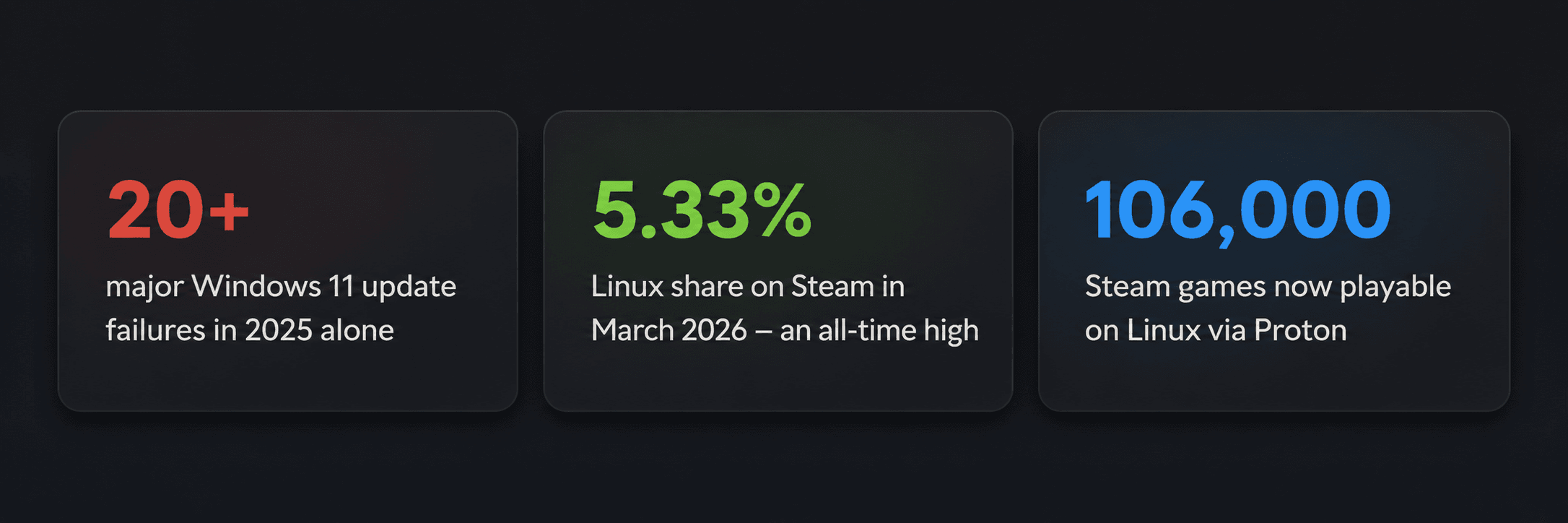
2025 was, by any fair measure, a catastrophe. More than twenty significant update failures in a single year. Updates stuck in install-fail-revert loops. A File Explorer toolbar that became entirely unclickable after a patch. The first update of 2026 immediately caused black screens, broken shutdown, and Outlook crashes across millions of machines. Microsoft's response was to release an emergency out-of-band patch, and then another one the week after to fix what the first emergency patch broke.
"Windows is at breaking point, and Microsoft knows it." — The Verge, January 2026
While all of this was happening, Microsoft was busy stuffing Copilot into Paint. Into Notepad. Into the Snipping Tool. Into the taskbar. Into Photos. Copilot buttons appeared in apps that had been blissfully simple for twenty years, and none of them worked well enough to justify the intrusion. The internet responded by coining "Microslop" and it stuck, because it's accurate.
Microsoft has since acknowledged the problem. CEO Satya Nadella pledged to "win back fans." Windows chief Pavan Davuluri published a post promising better performance, fewer Copilot entry points, and the return of taskbar flexibility that was removed at launch. A Microsoft VP said publicly that he "hates" the forced Microsoft account requirement. These are genuine admissions from a company that usually pretends everything is fine. Whether any of it materializes in time to matter is a different question, the track record of Windows 11 promises is written in five years of broken patch notes.
And yet: for gaming on an NVIDIA GPU, Windows remains effectively non-negotiable. Not because it's good. Because the ecosystem, game compatibility, driver support, anti-cheat systems, ancient titles from 2003 that somehow still work was built there and hasn't fully moved. When it comes to running older Windows-native games, Windows is still second to none. That's a frustrating thing to admit. It doesn't make Windows 11 less of a mess. It just means the mess is sometimes load-bearing.
macOS: the OS that gets out of your way, until it doesn't
macOS on Apple Silicon is, from a pure development experience standpoint, extraordinary. The Unix foundation means your terminal tools, your SSH config, your Docker containers, your shell scripts, they just work. Homebrew fills the gaps that Apple's package ecosystem doesn't cover. The M-series chips run Linux workloads in local containers with embarrassingly good performance and battery life that doesn't crater under sustained load. Major tech organizations routinely develop locally on macOS and deploy to Linux in production. That's not a coincidence. It's a workflow that genuinely makes sense.
For creative work, audio production, video editing, design, macOS is similarly hard to argue with. Adobe's suite runs natively on Apple Silicon. Final Cut is still the fastest video editor on any platform. Logic Pro exists. The display calibration is excellent. The hardware and software feel like they were designed together, because they were.
Full disclosure: I run Linux as my daily personal machine and at work for DevOps. MacOS I use on an M1 Pro, it genuinely gets out of the way in a way Windows never has. Both things are true simultaneously, which is the honest answer to most OS debates.
But macOS has a side it doesn't advertise, and it gets less optional with every release.
Gatekeeper and notarization. Apple's system for controlling what software can run on your Mac — are no longer just background processes. On macOS Sequoia and later, software distributed outside the App Store must be code-signed with an Apple Developer certificate ($100/year, mandatory renewal) and notarized through Apple's servers, which scan and cryptographically stamp every build before it's allowed to run. There is no user-friendly bypass. For users, this means enthusiast software and open-source tools from unknown developers may simply not open. For developers, it means paying Apple annually just to ship a free app, and if the notarization servers have a bad day, your users can't get an emergency bug fix until Apple's infrastructure cooperates.
macOS: what they don't put in the ads
- macOS Tahoe (2025) dropped all Intel Mac support. If you bought a high-end Intel Mac in 2020, it's now a legacy device. That's a five-year lifecycle for expensive hardware.
- Every app distributed outside the App Store requires a paid Apple Developer account to notarize. Open source developers pay $100/year to give software away for free.
- App Store review for Mac apps now takes 5–7 days on average in 2026, up from under 24 hours. Emergency bug fixes sit in a queue.
- Apple Intelligence the "private, on-device AI", has been rolling out unevenly since Sequoia and still has features delayed into 2026. Sound familiar?
- You cannot legally run macOS on non-Apple hardware. If you want the Unix experience without the Apple tax, Linux is the answer which is exactly the point.
None of this makes macOS bad. It makes it a genuinely excellent platform with a specific set of trade-offs that Apple would prefer you not dwell on. The walled garden is real, it's getting higher, and the EU's Digital Markets Act is currently in a legal battle with Apple over whether notarization itself constitutes anti-competitive gatekeeping. That case has legs because the argument has merit.
Linux: genuinely, measurably better with honest caveats
For DevOps and infrastructure work, Linux as a daily driver is close to unbeatable. The tools are native. Docker runs without emulation. Your production environment and your local environment speak the same language. Shell scripts behave the same way. There's no translation layer, no Windows Subsystem for Linux shimming things together, no "this works on macOS but not quite the same way in production." It just works, in the specific and important sense that matters most for the job.
The gaming picture has also shifted dramatically. Proton now makes around 106,000 Steam games playable on Linux up from roughly 9,000 native titles. About 90% of Windows titles launch on Linux at all. Linux hit 5.33% of Steam's user base in March 2026, doubling in a year, with Windows dropping to 60.8%, its lowest share since 2009. Some of that growth is Steam Deck users. But SteamOS is only about 25% of Linux Steam users. The rest chose desktop Linux deliberately.
Windows 10 hitting end-of-life in October 2025 accelerated everything. Microsoft's solution for the hundreds of millions of PCs that don't meet Windows 11's TPM 2.0 requirement was, essentially, "buy new hardware." A lot of people looked at that suggestion, looked at Windows 11's track record, and reached for a USB stick instead.
But Linux has real problems, and pretending otherwise doesn't help anyone switch successfully.
Linux: the honest caveats
- Hardware vendors build for Windows first. Laptop webcams, fingerprint readers, and proprietary Wi-Fi cards may have no Linux driver, or one that breaks after kernel updates with no fix timeline.
- NVIDIA on Linux is a project. The proprietary driver works, until a kernel update breaks the DKMS build. Fixing it requires comfort with a terminal. AMD is dramatically easier.
- OEM software doesn't exist. Fan curves, keyboard lighting, battery charge limits, the utilities your laptop manufacturer ships won't have Linux versions. Community tools often exist; they require finding and configuring.
- Adobe's suite, certain enterprise tools, and games with kernel-level anti-cheat don't run on Linux. These are real gaps, not things Proton can fix.
- HiDPI and multi-monitor setups have improved massively with Wayland, but edge cases persist, especially with mixed-refresh-rate or docking-station configurations.
Here's the thing that matters though: the people building Linux, fixing these drivers, maintaining these distros, they're doing it for free, in their spare time, because they believe software should serve the people who use it. You can be frustrated that your specific fingerprint reader doesn't work. You cannot reasonably be angry about it in the same way you can be angry at Microsoft for shipping twenty breaking updates in a year and charging you for the privilege of receiving ads in your Start menu.
The three-OS verdict
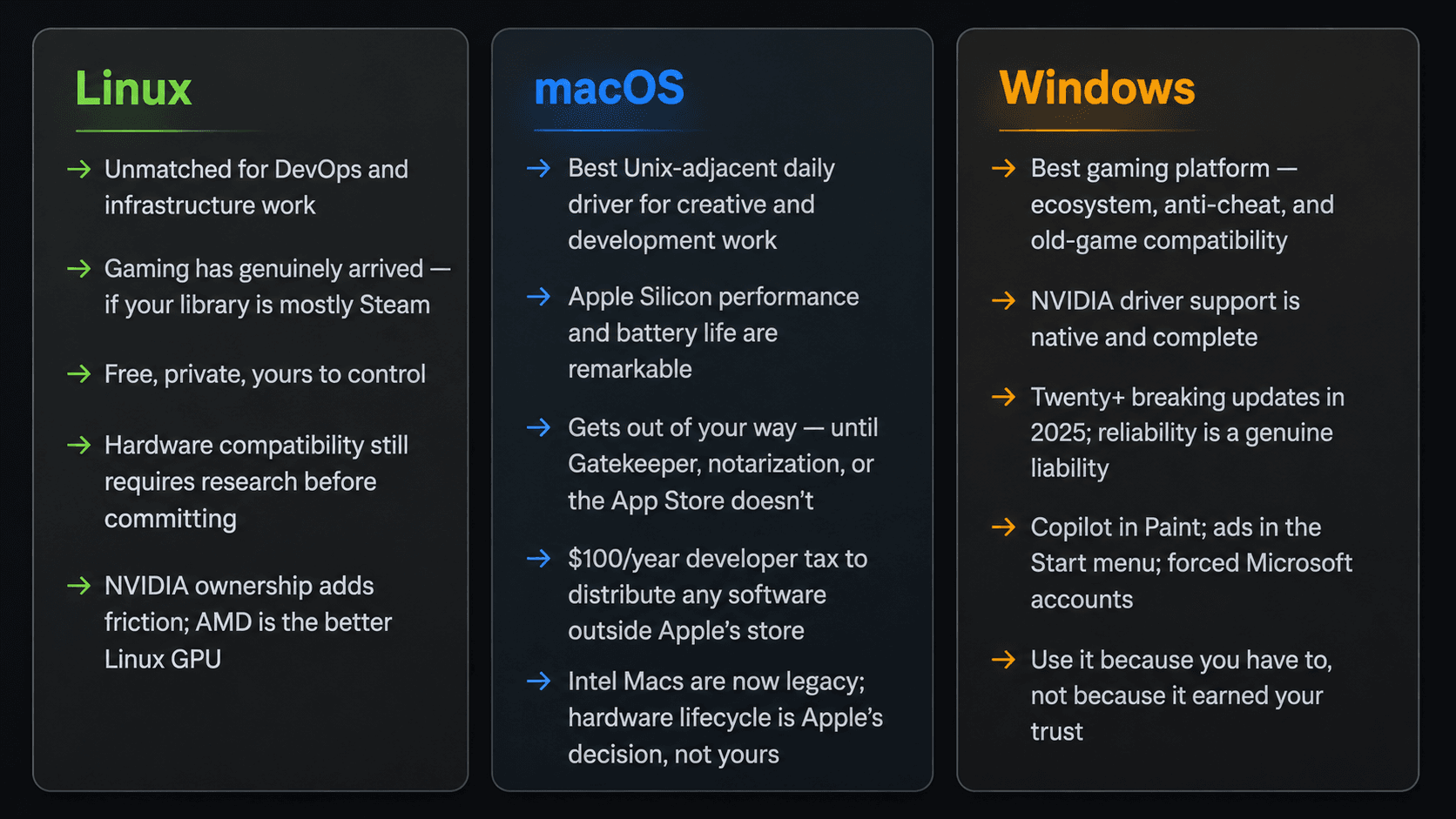
The year of the Linux desktop may never arrive the way the old joke imagined it, a single moment where Linux overtakes Windows and everyone switches at once. What's actually happening is more interesting. People are leaving Windows one broken update at a time. macOS is capturing the developers and creatives who can absorb the hardware cost and the walled-garden trade-offs. And Linux is ready to catch more people than it ever has been before, not everyone, but meaningfully more.
Use the right tool for the job. Check your hardware against the Linux Hardware Database before you switch. Run a live USB for a week. If everything works, it'll keep working. And if you're still on Windows because of gaming and an NVIDIA GPU — that's a completely legitimate reason. It doesn't make the Microslop any less real. It just means sometimes you need the mess because nothing else has the game library.
Editor's note: Steam figures from March 2026 may fluctuate, Valve has historically revised monthly survey data. macOS Tahoe Intel support cutoff confirmed from Apple's developer documentation. Windows update failure count sourced from Windows Latest's 2025 retrospective. The $100/year Apple Developer fee and notarization requirements are current as of May 2026.
About the Author