
On 31 July 2026, the EU's Right to Repair Directive became applicable across the bloc. The headlines said Europeans can now demand repairs, and that is partly true. It is also narrower, vaguer and more unevenly enforced than most of the coverage lets on.
We went through the directive text, the Commission's own guidance, and the reports from consumer groups and repair campaigners, and checked the numbers against the original sources wherever we could. Where something could not be confirmed, we say so. Here is what you can actually demand, what the law still does not fix, and how to use it.
What you can demand
The directive works on two levels: while the seller is still liable, and after.
Inside the legal guarantee. If a product fails and you choose repair over replacement, the seller's liability period is extended by 12 months. The extension applies to the whole product and only once, and only for goods bought from 31 July 2026. Sellers must tell you that you can choose between repair and replacement. A seller can still refuse repair if it would be disproportionately costly compared to replacing the product.
After the guarantee. For covered products, you can ask the manufacturer to repair, at a reasonable price and within a reasonable time. According to the Commission's own FAQ, this applies even to products bought before 31 July, for as long as the manufacturer must keep supplying the relevant spare parts, which in practice is roughly 5 to 10 years depending on the product. Non-EU brands are covered too: the duty falls on their EU representative, then the importer, and as a last resort the seller.
No obstruction. Manufacturers can't use contract terms, hardware or software techniques that impede repair, unless justified by legitimate and objective factors. Independent repairers must be able to use original, second-hand, compatible and 3D-printed parts that meet legal requirements. A manufacturer also can't refuse repair for purely economic reasons, or just because someone else repaired the product before.
Information. Manufacturers must publish information on their repair services and indicative prices for typical repairs, on a free-to-access site. Repairers may hand you a standardised European Repair Information Form, a quote covering the defect, the price, the time needed and the availability of parts. It is voluntary, but if a repairer gives you one, its conditions are binding for at least 30 days.
This is all for consumers. Business-to-business sales are outside it.
What is actually covered
The manufacturer repair duty is not a general right to repair everything. It only applies to products listed in the directive's Annex II, and only to the extent that separate EU rules set repairability requirements for them. Right to Repair Europe lists washing machines and washer-dryers, dishwashers, fridges, electronic displays, welding equipment, servers and data storage, phones and tablets, tumble dryers and local space heaters, with e-bike and e-scooter batteries joining from 18 February 2027.
Vacuum cleaners appear on the list, but the same group points out that the ecodesign rule they are tied to contains no repairability requirements, so there is nothing to enforce until a new rule arrives. BEUC's report says the Commission is expected to publish draft measures for vacuum cleaners later this year. Computers and printers are not on the list at all, and BEUC wants them added.
The extra guarantee year, by contrast, applies to all consumer goods.
"Reasonable price" means whatever gets argued
The directive says spare parts and repairs must be offered at a reasonable price, meaning one that does not deter repair. The Commission's guidance says manufacturers should set prices case by case, taking the value of the product into account. There is no formula, no cap and no benchmark.
The most concrete proposal on the table comes from Right to Repair Europe's white paper on spare parts prices. Manufacturers would declare a maximum pre-tax price for every spare part, and that declared price would become a binding ceiling. The price would also feed into the repairability score, so that a product whose parts cost over 28% of its price scores zero on that criterion.
Where do their numbers come from? Surveys and studies cited in the paper suggest consumers abandon repair once the total cost passes roughly 30% of the price of a new product (the French environment agency ADEME puts it at 30%, and a French survey found half of respondents give up above 25%). The Commission's own impact assessment landed on about 20% on average. Because a repair bill is labour plus parts, the paper estimates parts should stay under 15 to 20% of the product price. That is an estimate of what "reasonable" would need to look like, not a rule anyone has adopted.
Some companies already accept ceilings. The paper says products certified under the French LONGTIME label carry parts price caps averaging 25% of the new product price, ranging from 10% to 40% by product type, and the label covers brands such as Whirlpool, Kenwood and De'Longhi. Fairphone is cited separately for keeping spare parts prices largely stable for about a decade.
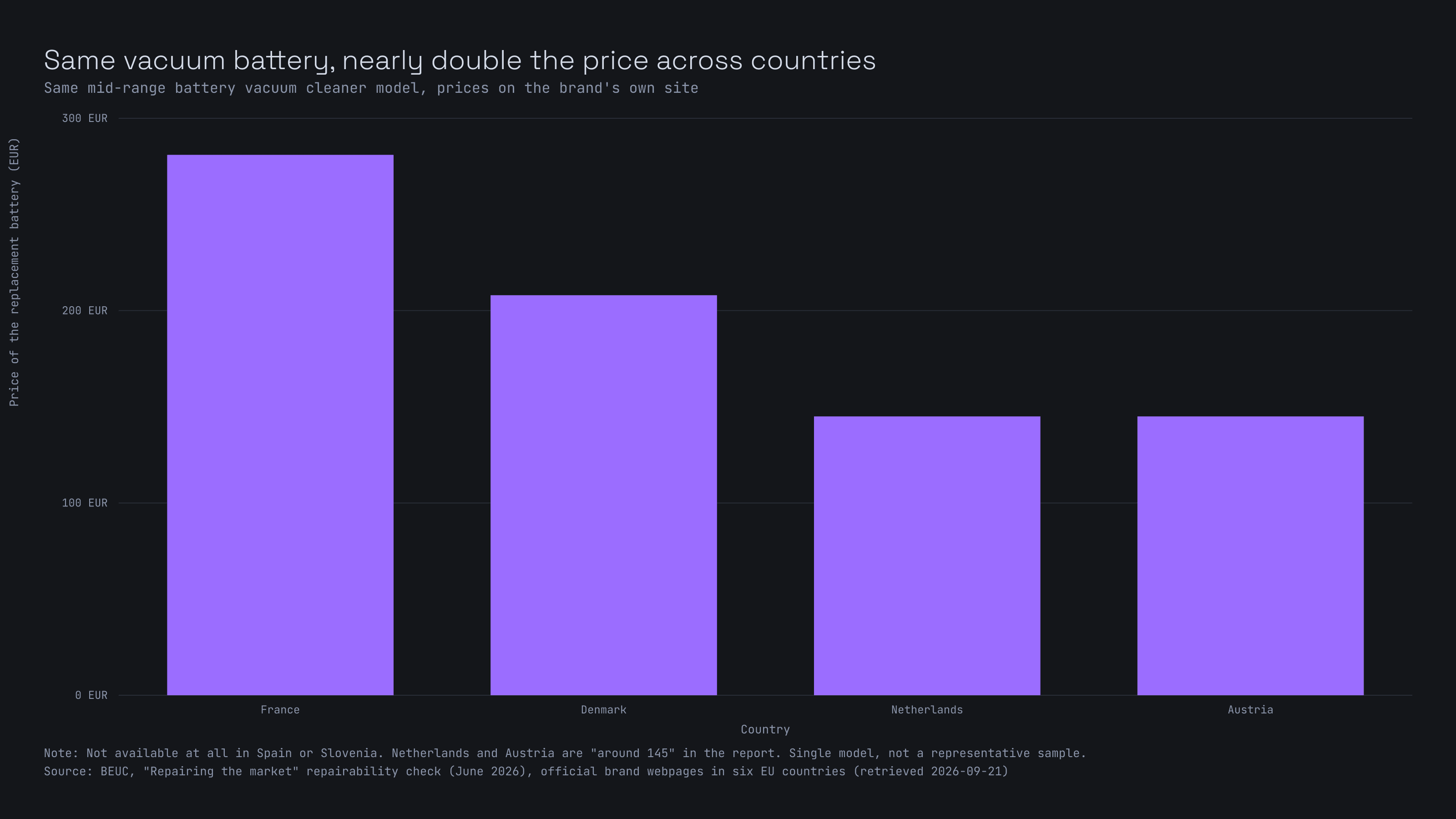
Real prices, from BEUC's market check of smartphones and battery vacuum cleaners across six countries (Austria, Denmark, France, Slovenia, Spain and the Netherlands), show why this matters. The priciest smartphone part they found was a €400 display, about 30% of the phone's price. For a recent high-end phone, the battery was around €109, roughly 10% of the price, against about €35 for a mid-range one. For one mid-range vacuum, the same battery cost €281 in France, about €145 in the Netherlands and Austria and €208 in Denmark, and was not available at all in Spain and Slovenia. BEUC stresses that its sample is limited and not statistically representative, and its own summary and report state the ratio for that €281 battery differently, so treat the euro amounts as the reliable part.
Euronews quoted the Parliament's rapporteur on the file, René Repasi, arguing that a part costing pennies to make and sold for hundreds of euros is plainly unreasonable, but that without a legal definition some manufacturers will bet consumers don't know they can push back. We could not find his original remarks, so that comes second-hand.
The parts pairing loophole
The no-obstruction rule has an escape hatch: the ban applies "unless justified by legitimate and objective factors," and the text names protection of intellectual property as one of them. Right to Repair Europe called this a "gaping loophole" in a 2024 paper.
Parts pairing is when a component is tied to one specific device by software, so a replacement part may not work fully until the manufacturer re-authorises it. The directive's software rule also applies without prejudice to more specific product rules. According to that same 2024 paper, the ecodesign rule for smartphones explicitly allows pairing as long as manufacturers give non-discriminatory access to the re-pairing procedure, with up to three working days to do it, and a possible ban would be considered when that rule is reviewed in 2027. That was the position when the paper was written, so check it against the current text before relying on it.
For a repairer with a phone that needs half an hour of work, three days of waiting is a long time.
Rules on paper, gaps in the registry
The clearest evidence of an enforcement problem does not actually come from the new directive. It comes from the older ecodesign rules for smartphones and tablets, in force since 20 June 2025. Those require manufacturers to publish repair instructions and spare parts prices, and to list the link to that information in a public EU product database (EPREL).
In September, Right to Repair Europe and iFixit published a review of that database. Of 2,334 smartphone records from the past year, only about 18% listed a website where parts prices or repair instructions could readily be found. About half had a blank where the link should be, 19% linked to a page with neither, 8% gave a useless reference like "see manual", and close to 5% pointed to Temu or AliExpress. Some records with empty repair fields still gave themselves the top repairability class. Acer's "indicative" price for a tablet battery ran from €14 to €128.
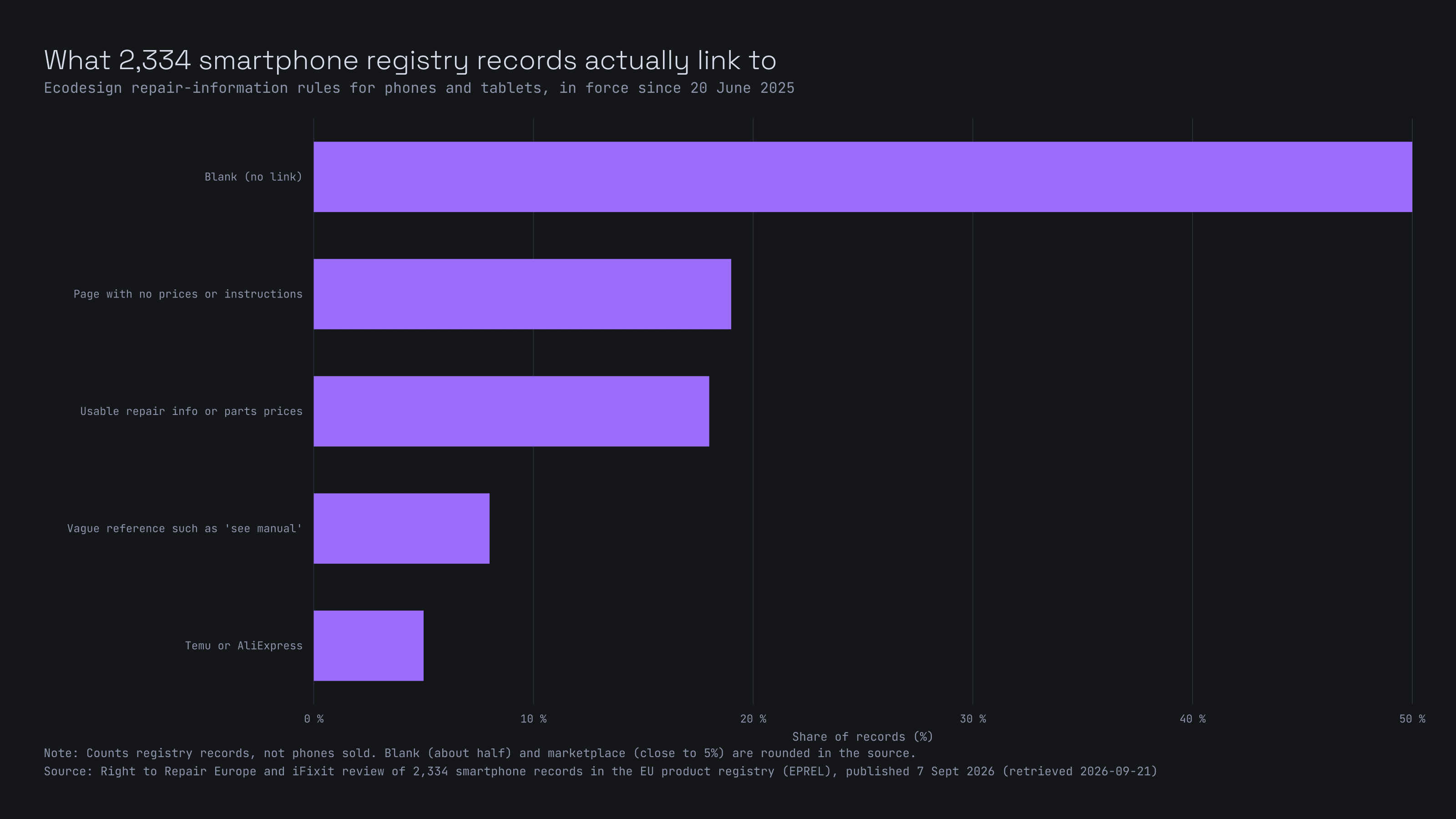
A few things to keep in mind before repeating that headline. The figure counts registry records, not phones sold, so it says nothing about how many people's actual phones are affected. The review comes from campaign groups, has not been independently repeated as far as we can tell, and the underlying dataset is not published (they offer it to journalists and authorities). The record count is also at odds with BEUC's finding that regulated smartphones generally come with comprehensive repair instructions. The likeliest explanation is that BEUC sampled the brands people actually buy while the registry also holds many obscure entries, though nobody has weighted the data by sales. And even the big brands were described as taking some clicking around to reach parts prices.
The worrying part is the follow-up. iFixit argues that no authority has checked blank fields that anyone could spot, and that under-resourced national agencies leave NGOs to do the monitoring. The same authorities are now supposed to enforce a far bigger directive.
A patchwork rollout
A directive is not directly applicable, so the repair duty only reaches manufacturers once a country has turned it into national law. On 30 July, Right to Repair Europe said only a handful of member states had formally notified the Commission that they were done, with a few more well advanced and many behind. Which country you live in therefore matters.
Ireland, for one, got there, with a statutory instrument (S.I. 353 of 2026) that was later replaced by another to correct a technical error. Other pieces arrive later: the Commission's common repair platform interface is due by 31 July 2027 and the European platform should be fully operational by 1 January 2028. Countries also have until 31 July 2029 to notify at least one measure promoting repair, like repair vouchers.
What about Cyprus?
Cyprus's Consumer Protection Service put a draft law, "The Common Rules Promoting the Repair of Goods Law of 2026", out for public consultation in June 2025, along with companion amendments to the sale of goods legislation. We could not confirm whether the House of Representatives has passed it. If you are in Cyprus, check with the Consumer Protection Service before assuming the full set of rights applies.
How to use it
- **Check the product is covered.** Is it in one of the Annex II categories, and does the manufacturer publish a repair page for that model?
- **Under guarantee, choose repair on purpose.** For purchases from 31 July 2026, repair earns you the extra 12 months. Ask the seller to confirm it in writing.
- **Past the guarantee, ask the manufacturer in writing.** Request the price and timeframe, and remember they can't refuse simply because someone else has repaired the product before.
- **Get quotes.** Ask independent repairers for the European Repair Information Form. If they give you one, the terms are locked for 30 days.
- **Do the maths.** If the total repair cost is heading past about 30% of a new equivalent, you have the same problem the studies describe, and a good reason to push back on the price.
- **For phones and tablets, check the EPREL entry** behind the QR code on the energy label. A blank repair link is worth reporting. The register has a report function, though iFixit says it is barely publicised.
- **Complain to your national consumer authority** if the manufacturer stonewalls you.
Our take
The directive is a floor, not a victory. The rights are real, and independent repairers and consumers now have a legal argument they lacked a year ago. But the scope is narrow, the price rule is vague, the anti-lock rule has a wide exception, the enforcement infrastructure is thin, and where you live decides how much of it you get.
BEUC's finding is the one to hold on to: where repairability rules exist, as with smartphones, access to parts and instructions is better than where they don't. That is an argument for widening the rules, not for treating them as done. Judge the law by what happens at the repair bench and on the parts price list over the next year, not by the press release.
About the Author