
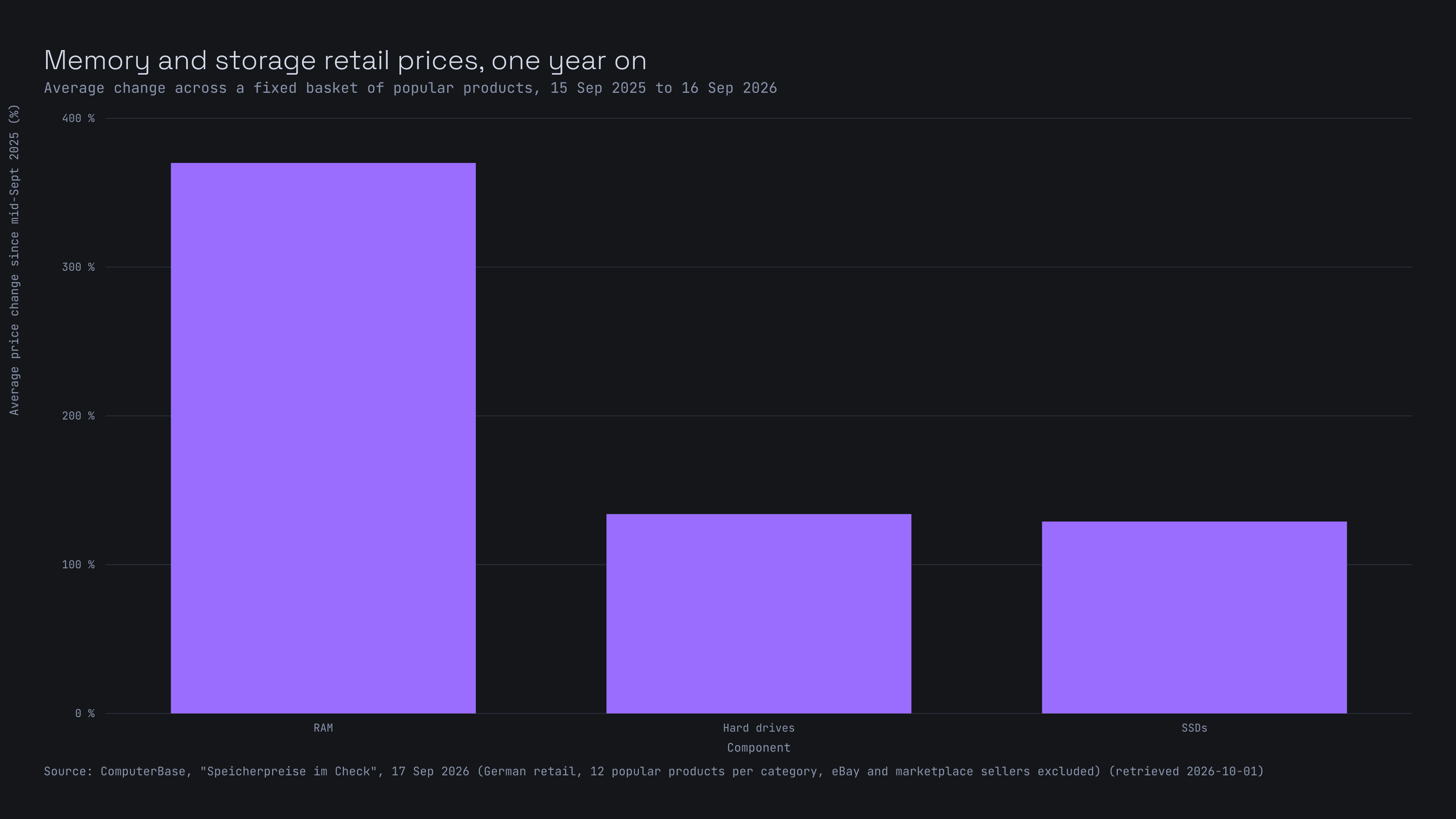
Pick a number. RAM is up 370% on a year ago. Hard drives are up 134%. SSDs are up 129%.
Those are ComputerBase's figures from 16 September, tracking a dozen popular products per category in German retail since mid-September 2025. It leaves out eBay and marketplace sellers, so nobody gets to blame scalpers. This is simply what the shelf costs now.
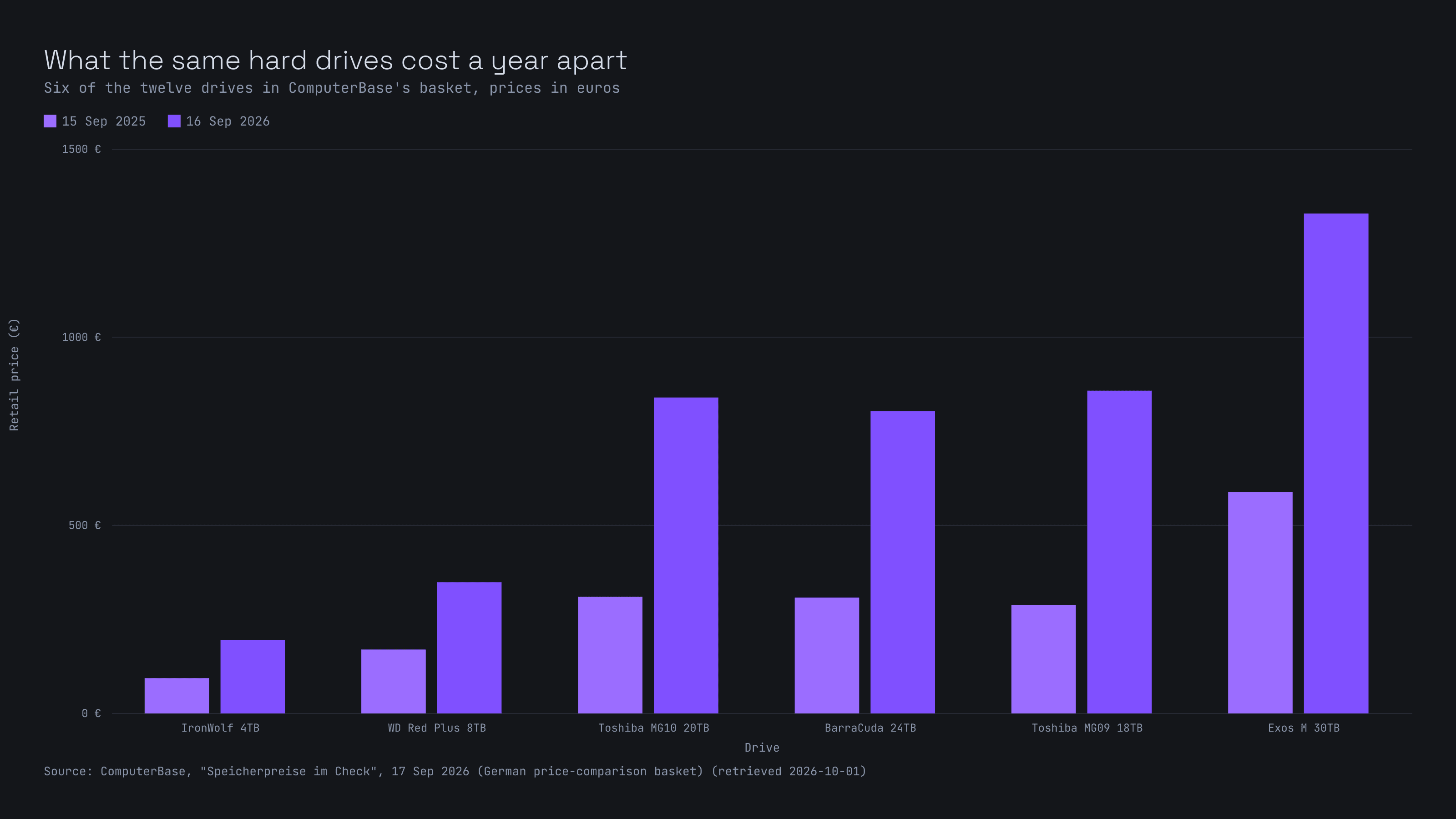
It gets worse on a real part. Seagate's BarraCuda 24TB was €308 a year ago. It is €804 today. Fill a six-bay NAS with them and the drive bill goes from about €1,850 to about €4,820. Same drives, same NAS, nothing new in the box.
Where things stand today
RAM. A 32GB DDR5-6000 kit was around €114 last September. PC Games Hardware recorded €523 in August. In the US, 32GB of DDR5 now starts around $375.
Hard drives. ComputerBase's basket was up 46% in January, then 125% in July, 129% in August and 134% now. It has not levelled off. It is still adding about five points a month. In the US, a September check by MakeUseOf found new 8TB drives at $41 per terabyte for the cheapest IronWolf and $50 for an Exos. The BarraCuda above went from roughly €13 per terabyte to roughly €33. The one bit of consolation is that spinning disks still cost around a third of SSDs per terabyte, so the cheap option is still the cheap option. It is just not cheap.
SSDs. Up 129%, and TrendForce expects NAND contract prices to rise another 10 to 15% this quarter. That is slower than before. Slower growth is not lower prices.
GPUs. Reports citing Tom's Hardware's tracking put a new RTX 5090 at $5,000 or more in North America, against a $1,999 launch price. Nvidia has reportedly raised the price of the GPU and memory kits it sells to board partners, because graphics cards are fighting over the same memory as everything else.
Consoles and devices. Nintendo put the Switch 2 up $50 to $499.99 on 1 September. CNN reports that the head of Microsoft's Xbox division called this "the most severe hardware crisis in history" in an internal email.
What hasn't moved. Not everything. One builder's September re-check of its own published parts lists found coolers and desktop CPUs close to flat, and the cheapest motherboard got cheaper. The parts that exploded are the ones with memory in them.
Why it's this bad
You already know the answer, but the numbers are worse than the headline.
Seagate said on its July earnings call that data centers now make up about 90% of its exabyte shipments. Most of its high-capacity output is already allocated into 2028, and contracts covering all of 2027 have their prices set. It has also kept the number of drives it builds flat since the last downturn, and grows capacity by cramming more onto each disk instead. Western Digital reported a 44% operating margin in August and said it is negotiating supply agreements out to 2029, 2030 and 2031. On pricing, it said it has had more room to push prices up faster outside the data center business. That includes the drives we buy.
Retail gets what's left. TrendForce says the memory price slowdown has little to do with supply loosening. Memory makers are steering wafers toward data center parts, and buyers have simply run out of room to pay.
Will it come down?
Not soon, and I would not bet on all the way.
The last time hard drives spiked was the 2011 Thailand floods. Supply was back near pre-flood levels within months, and retail prices were still about 75% higher. The makers posted record profits. Backblaze says its cost per gigabyte took two years to recover. That was a flood with an end date. This is contracted demand with no end date in sight.
The structure doesn't help. Three companies make hard drives and three make nearly all the DRAM. Morgan Stanley analysts, as summarised by Futu News, put the two big drive makers' combined 2026 capex near $1 billion, against more than $90 billion from the top five memory makers, and expect the drive shortage to last into 2029. They also expect margins in the mid-to-high 50s. There is not much commercial reason to add capacity and make a product cheaper while scarcity pays this well.
On memory there is something harder than a hunch. On 25 June, a class action was filed in California against Samsung, SK hynix and Micron, which Counterpoint puts at roughly 89% of DRAM revenue. It alleges they coordinated to restrict conventional DRAM supply while shifting capacity to AI memory. SK hynix confirms the suit in its SEC filing. Micron denies it. These are allegations, and plaintiffs will have to show coordination rather than three companies making the same profitable choice on their own. But Samsung and Hynix pleaded guilty to DRAM price-fixing in the 2000s, with fines of $300 million and $185 million. It is not a conspiracy theory to ask the question.
To be fair, memory is cyclical, the rate of increase is slowing, and CNN's reporting says the shortage is expected to run until at least 2028. Some analysts reportedly don't expect pre-shortage prices to come back even after that. Nobody can promise you a number. What we can say is that nothing in the contracts, the capex or the market structure says cheap again, and plenty says otherwise.
The point
Owning your own storage is turning into a luxury product. A NAS, a homelab, a Plex server, a backup you control yourself: all of it just got priced for someone else, because the biggest buyers signed for the supply years in advance and we are fighting over the remainder.
If you have to buy, buy on price per terabyte instead of sticker price, check for CMR before you put anything in a RAID array, and don't assume next quarter will be cheaper. Prices have climbed every time ComputerBase has checked since January, and Seagate's CFO has told investors there is room to keep pushing pricing.
About the Author